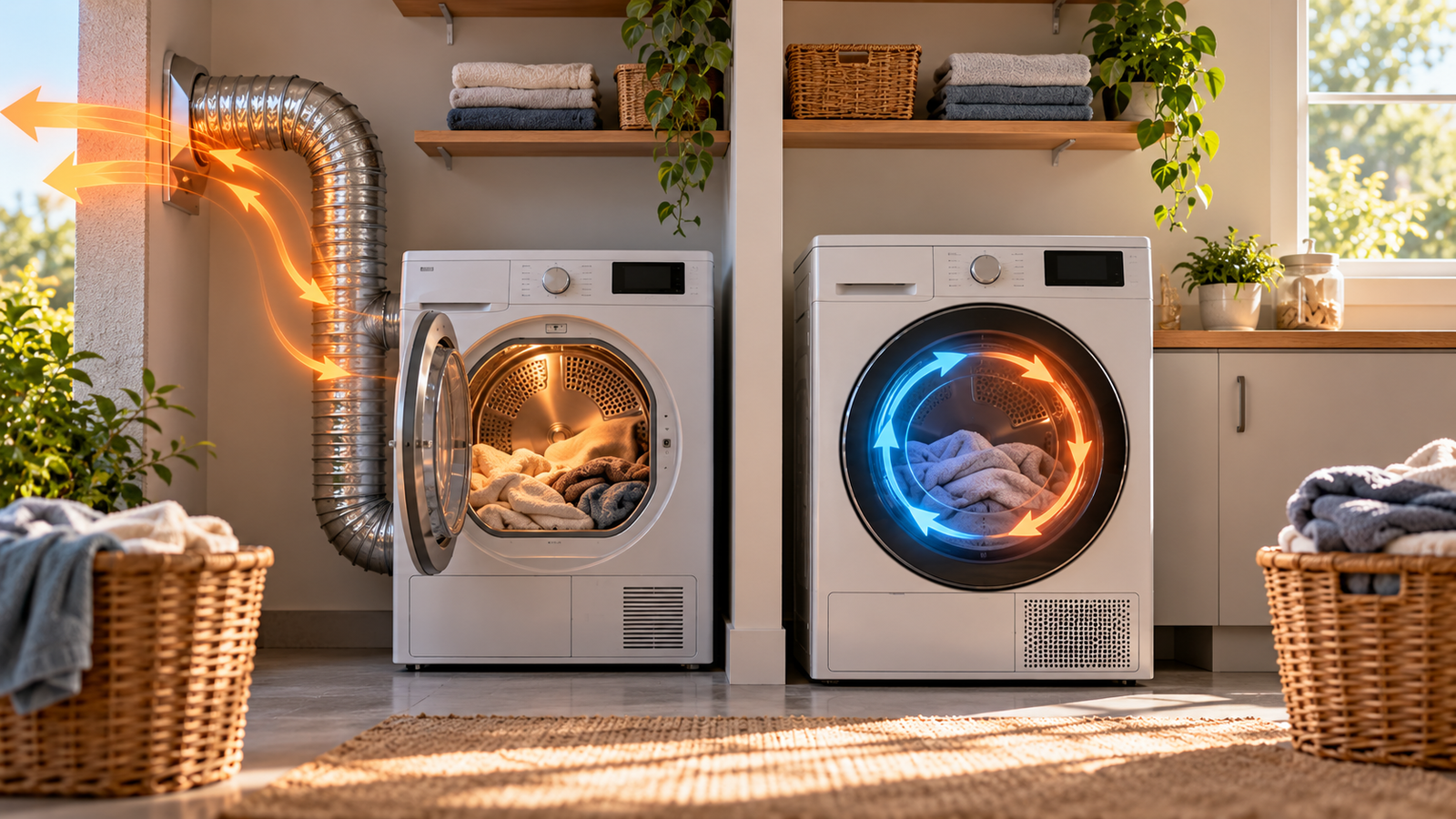
Quick answer: A heat pump dryer generally uses much less electricity than a conventional electric-resistance dryer, but it usually costs more upfront and may take longer to dry clothes. ENERGY STAR says certified heat pump dryers use around 70% less energy than conventional dryers; actual savings depend on the models and your laundry habits. See ENERGY STAR’s guidance.
Which should you choose? A heat pump dryer is worth considering if you dry clothes frequently, pay high electricity rates, expect to keep it for years, or need a ventless installation. A conventional electric dryer may make more financial sense if you do little laundry, already have a suitable vent, or need a lower purchase price.
Compare the dollars: Subtract the two models’ annual kWh figures (from EnergyGuide or manufacturer documentation), multiply by your own electricity rate, and compare the annual saving with the extra purchase and installation cost. For example, a hypothetical 400 kWh/year difference at $0.18/kWh saves $72/year in electricity. See the calculation method.
Heat pump dryer vs conventional electric dryer
| Factor | Heat pump dryer | Conventional electric dryer |
|---|---|---|
| Heating method | Heat pump captures and recirculates heat | Electric resistance creates heat |
| Energy use | Typically much lower | Typically higher |
| Venting | Usually ventless | Usually vents outdoors |
| Upfront price | Typically higher | Typically lower |
| Drying behavior | Often lower-temperature and may take longer | Often higher-temperature and faster |
| Installation flexibility | No exterior dryer vent needed, but model requirements still apply | Requires a properly installed exhaust vent |
Why heat pump dryers use less electricity
A conventional electric dryer uses resistance heat to warm air, passes that air through the clothes, and then sends much of the heated air outdoors through the vent. A heat pump dryer works more like a closed-loop refrigeration system: it removes moisture from the air and reuses heat within the drying process.
ENERGY STAR says certified heat pump dryers use around 70% less energy than conventional dryers. That is an equipment-energy comparison, not a promise that your total household electricity bill will fall by 70%. Laundry is only one part of the bill, and actual savings depend on how often you dry clothes and which specific models you compare.
How to compare dryer operating cost
The cleanest method is to compare model-specific annual electricity consumption from the EnergyGuide label or manufacturer documentation.
Annual operating cost = annual kWh × electricity price per kWh
Using the hypothetical 400 kWh/year difference from the quick answer and a sample rate of $0.18/kWh gives $72/year in electricity savings. These figures illustrate the method; they are not typical-model claims or a fixed U.S. electricity rate. Use the annual kWh figures for the two models and the price on your own bill.
BoodBill Energy Tools
Dryer electricity cost
Use kWh per drying cycle for a representative load.
Load size and moisture affect consumption. For gas dryers, this estimates electricity only, not gas cost.
How we calculated this
All periods use a 365.25-day year: 365.25 ÷ 7 weeks and 12 average months. Daily and weekly figures are averages, including days the appliance is not used.
Estimates cover electricity operating costs only. They do not model time-of-use pricing, demand charges, tiered rates, or changes in behavior and weather.
Private by design: calculations stay in this page. No account, storage, or external calculation service.
If you need a refresher on the unit behind these calculations, see what a kWh means and how to read it on your electric bill.
Calculate whether the higher price pays back
Once you know the expected annual electricity-cost difference, calculate a simple payback:
Simple payback = extra purchase/installation cost ÷ estimated annual electricity savings
If the heat pump dryer costs $600 more and your model-specific calculation suggests $75 per year in savings, the simple payback is eight years. If you do far more laundry or pay a higher electricity rate, the savings could be larger; with light usage, they could be smaller.
This is a screening calculation, not a full life-cycle analysis. Reliability, repair costs, financing, equipment life, future energy prices and resale value can all change the economics.
If you are comparing your entire laundry routine, our washing machine electricity-use guide explains how wash settings and water heating affect energy consumption before clothes reach the dryer.
Drying time and temperature
Heat pump dryers generally operate at lower temperatures than conventional resistance dryers. That can be gentler on fabrics, but cycles may take longer depending on the model, load and selected program.
Do not compare dryers only by advertised cycle time. A useful comparison includes energy per cycle, capacity, moisture sensing, how you actually sort laundry, and whether the longer cycle affects your household routine.
Ventless installation is a major difference
Most heat pump dryers are ventless, so they do not require the traditional exhaust duct running to the exterior. That can be valuable in apartments, interior laundry rooms, or remodels where adding a compliant dryer vent is difficult.
A conventional vented electric dryer needs a correctly installed and maintained exhaust system. Poor venting is not merely an energy issue; lint buildup and improper installation can also create safety problems. Follow the appliance manufacturer’s installation and maintenance instructions.
Does a heat pump dryer need a drain?
Heat pump dryers remove moisture from clothing by condensing water. Depending on the model, that water may collect in a reservoir you empty manually or drain through a hose. Check the specific model before planning the installation.
What about room heating and cooling?
A vented dryer exhausts heated indoor air to the outside, which can indirectly affect the home’s heating or cooling load because replacement air has to enter the building. A ventless heat pump dryer avoids that exhaust-air pathway, although the appliance still exchanges some heat with the room.
The size of this secondary HVAC effect depends heavily on climate, building tightness, dryer location and usage, so BoodBill does not assign a universal dollar saving to it.
When a heat pump dryer is more likely to make sense
- You do many loads of laundry each week.
- Your electricity price makes efficiency savings valuable.
- You expect to keep the dryer for many years.
- You need or strongly prefer a ventless installation.
- You value lower-temperature fabric care.
- The price premium over a conventional dryer is reasonable.
When a conventional electric dryer may still make sense
- Your laundry volume is low, so annual energy savings are small in dollars.
- Upfront purchase price is the main constraint.
- You already have a good, code-compliant vent installation.
- You strongly prioritize shorter drying cycles.
- The heat pump model’s extra cost would take longer to recover than you expect to own it.
Do not confuse efficiency with guaranteed savings
A dryer can be dramatically more efficient and still have a long financial payback if you use it infrequently or pay a large price premium. Conversely, a household running many dryer loads at a high electricity rate may place much more value on efficiency.
The same principle applies to other heat-pump appliances. Our heat pump water heater vs electric water heater comparison uses the same approach: separate the energy advantage from the purchase economics.
Could your dryer be contributing to a high electric bill?
Yes, particularly in a household doing frequent loads, but do not assume it is the sole culprit. Dryers operate intermittently, while HVAC, water heating, refrigeration and other loads can also be important. If your bill changed unexpectedly, use our high electric bill troubleshooting guide to investigate systematically.
Ways to reduce dryer electricity use without replacing it
- Use moisture sensing when available. Avoid continuing to heat clothes after they are dry.
- Keep the lint filter clean. Follow the manufacturer’s instructions.
- Maintain the exhaust system on vented dryers. Restricted airflow can hurt performance and creates a maintenance concern.
- Use an appropriate spin speed in the washer. Removing more water before drying can reduce the work the dryer must do, where fabric-care instructions allow it.
- Avoid routinely overdrying. Choose the cycle that matches the load and fabric.
- Compare actual annual kWh when replacing the appliance. Purchase price alone does not show lifetime operating cost.
Frequently asked questions
Do heat pump dryers really use less electricity?
Yes. ENERGY STAR says certified heat pump dryers use around 70% less energy than conventional dryers. The exact difference between two models should be checked using their EnergyGuide or manufacturer energy data.
Are heat pump dryers cheaper to run?
Usually they should cost less in electricity for comparable drying service because they use less energy. Your dollar savings depend on loads per year, the specific dryers and your electricity rate.
Do heat pump dryers take longer?
They can. Their lower-temperature drying process may require longer cycles, although performance varies by model and program.
Do heat pump dryers need a vent?
Most are ventless. Always verify the installation requirements for the exact model you are considering.
Are heat pump dryers worth it?
They can be, especially for frequent dryer users, high electricity rates, long ownership periods, or installations where ventless operation has extra value. Calculate the extra upfront cost against model-specific annual electricity savings rather than assuming the answer is always yes.
The bottom line
A heat pump dryer has a clear efficiency advantage over a conventional electric-resistance dryer, but the financial decision is household-specific. Compare annual kWh for the actual models, multiply by your electricity rate, calculate the yearly difference, and compare that with the price premium.
Then include the practical factors—cycle time, capacity, venting, space and how often you do laundry. That gives you a much better answer than choosing solely from an efficiency percentage or sticker price.
Use the main electricity cost calculator for other household appliances.
Sources
- ENERGY STAR — Heat Pump Dryers (accessed October 6, 2026).
- U.S. Department of Energy — Clothes Dryers (accessed October 6, 2026).
- U.S. Energy Information Administration — Electric Power Monthly (accessed October 6, 2026).
Example costs are BoodBill calculations from explicitly stated assumptions and are for general information only. Where an article labels consumption figures as hypothetical or illustrative, they are not claims about typical model consumption.