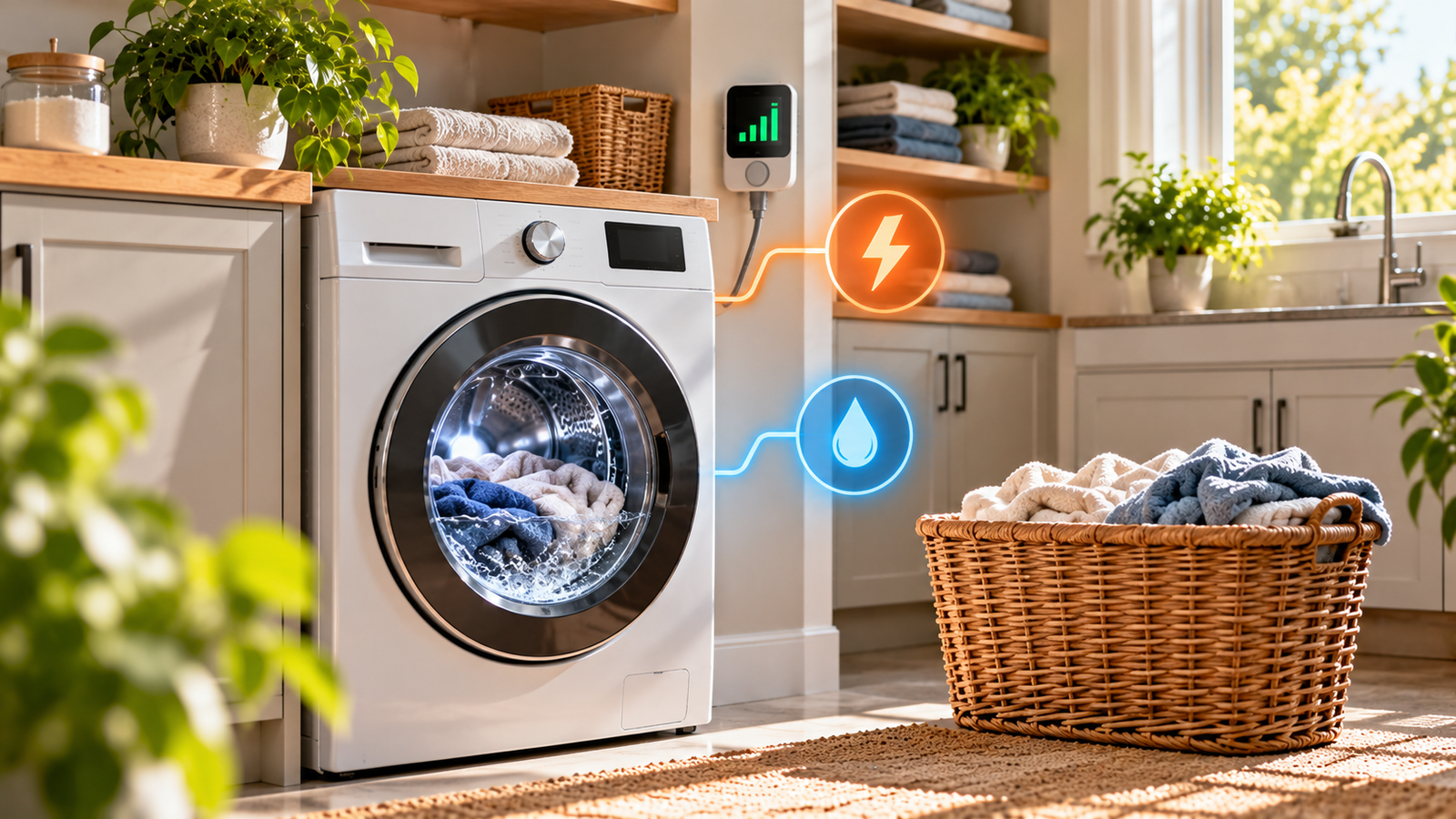
A washing machine usually is not one of the biggest direct electricity users in a home, but the complete cost of a load is easy to underestimate. The washer uses electricity to turn the drum, run pumps and controls, while a warm or hot cycle can also require energy to heat the water.
That means there is no useful single answer such as “every wash costs X cents.” The better approach is to separate the washer’s electricity from the energy used for hot water, then calculate with your own utility rates.
Quick answer: how much electricity does a washing machine use?
The amount varies by model, cycle, load, water temperature and efficiency. The most reliable number for a specific machine is its EnergyGuide information or manufacturer energy data rather than a generic wattage from the internet.
For cost calculations, use:
Electricity cost = kWh used × your electricity price per kWh
If your washer used 0.4 kWh for a particular load and electricity cost 18.31¢/kWh, the washer-side electricity arithmetic would be about 7.3 cents. That is only an illustration: it does not include any separate energy required by your home’s water heater, and 0.4 kWh is an example assumption rather than a claim about every washer.
The 18.31¢ rate is the U.S. residential average electricity price reported by the U.S. Energy Information Administration for July 2026. Your actual utility rate may be substantially different, so use the price on your own bill whenever possible.
BoodBill Energy Tools
Washing machine electricity cost
Enter kWh for your usual wash cycle, and the number of cycles per week.
Hot-water energy may be supplied by a separate water heater and may not be included in the washer’s kWh.
How we calculated this
All periods use a 365.25-day year: 365.25 ÷ 7 weeks and 12 average months. Daily and weekly figures are averages, including days the appliance is not used.
Estimates cover electricity operating costs only. They do not model time-of-use pricing, demand charges, tiered rates, or changes in behavior and weather.
Private by design: calculations stay in this page. No account, storage, or external calculation service.
Why water temperature matters so much
When you choose a warm or hot wash, energy may be needed to heat the incoming water. That energy can be used outside the washer itself by your home’s water heater, which is why looking only at the washer’s plug load can understate the true energy cost of laundry.
ENERGY STAR emphasizes efficient clothes washers as a way to reduce both energy and water use. Less hot water can also mean less work for the water heater.
If you are comparing water-heating technologies, see our guide to heat-pump water heaters vs standard electric water heaters.
How to estimate the cost of your own washer
1. Find annual energy use or cycle data
Start with the EnergyGuide label, product documentation, or manufacturer specifications. Annual energy figures are much more useful than guessing from a machine’s maximum electrical rating.
2. Use your own electricity rate
Find the cents-per-kWh figure on your electricity bill and convert it to dollars before multiplying. For example, 20¢/kWh becomes $0.20/kWh.
If kWh is still confusing, read What Is a kWh? How to Read Your Electric Bill.
3. Account for hot-water energy
If you regularly wash with warm or hot water, remember that part of the laundry cost may appear through your water heater rather than through the washer’s labeled electrical consumption alone. The exact cost depends on water volume, incoming water temperature, selected wash temperature, and whether your water heater uses electricity, gas, or another fuel.
4. Think in annual loads
A few cents per cycle can become meaningful when multiplied across hundreds of loads. Conversely, a household that washes infrequently may not recover a large purchase-price premium purely through electricity savings.
Illustrative electricity-cost scenarios
The table below is arithmetic only. It shows what different per-load electricity-use assumptions would cost at 18.31¢/kWh; it is not a table of typical washer consumption.
| Assumed washer electricity per load | Cost per load | 200 loads/year | 300 loads/year |
|---|---|---|---|
| 0.2 kWh | $0.04 | $7.32 | $10.99 |
| 0.4 kWh | $0.07 | $14.65 | $21.97 |
| 0.6 kWh | $0.11 | $21.97 | $32.96 |
| 1.0 kWh | $0.18 | $36.62 | $54.93 |
Again, these are scenarios for understanding the math. Check your specific model rather than assuming your washer falls on one of these rows.
What makes one washer cheaper to run than another?
Efficiency
Efficient machines are designed to reduce energy and water consumption while still meeting cleaning-performance requirements. ENERGY STAR certification can help when comparing qualifying models, but purchase price, capacity, features and expected use still matter to the financial decision.
Water temperature
Cold-water cycles reduce or avoid much of the energy needed to heat wash water. Whether cold washing is appropriate depends on the laundry, detergent, fabric-care instructions and sanitation needs.
Load size and cycle selection
Specialty, heavy-duty, extra-rinse and other cycle choices can change water and electricity consumption. Avoid treating one cycle’s consumption as if it represented every cycle on the machine.
How often you wash
Annual operating cost is ultimately per-load cost multiplied by usage. A large household doing frequent laundry has more opportunity to benefit from efficiency than a household running only a few loads per week.
The washer can also affect your dryer bill
A washer with effective spin extraction leaves less water in clothing. That can reduce the work required by the dryer, so evaluating the washer and dryer as a system can be more useful than looking at either appliance in isolation.
If you are considering a dryer upgrade, see Heat Pump Dryer vs Electric Dryer: Is It Worth It?.
Ways to reduce laundry energy costs
- Use cold water when appropriate. This can reduce water-heating energy.
- Run sensible loads. Avoid repeatedly running tiny loads when they can reasonably be combined without overloading the machine.
- Choose the cycle you actually need. Extra rinses and specialized cycles can change resource use.
- Use high spin speeds when appropriate for the fabric. Removing more water in the washer can reduce dryer work.
- Compare EnergyGuide information when replacing a machine. Do not buy based only on marketing claims.
Should you replace an old washer just to save electricity?
Usually, electricity savings alone should not automatically trigger replacement of a functioning washer. Compare the expected operating-cost difference with the purchase and installation cost, and consider water savings, repair risk, capacity and how often your household does laundry.
This is the same principle we use throughout BoodBill: an appliance can be more efficient without automatically being the best financial upgrade for every home.
Frequently asked questions
Does a washing machine use a lot of electricity?
Compared with major heating and cooling loads, the washer’s direct electricity use may be modest, but laundry also interacts with water heating and drying. Look at the whole process rather than the washer plug alone.
Is a cold wash cheaper?
It can reduce the energy needed to heat water. The exact savings depend on how much hot water the alternative cycle would have used and what it costs your household to heat that water.
Does a longer cycle always use more electricity?
Not necessarily. Cycle duration alone does not tell you total energy use because motor operation, heating, water volume and control strategies vary by machine and program.
Why did my electric bill rise after doing more laundry?
More loads can increase washer, water-heater and dryer energy use. If the increase seems too large to explain by laundry alone, work through our high electric bill checklist instead of assuming one appliance is responsible.
The bottom line
To estimate washing-machine electricity cost accurately, start with your specific model’s energy information and your own electricity rate. Then remember that warm and hot washing can add water-heating energy that is not obvious from the washer’s direct consumption.
For households trying to cut laundry costs, water temperature, sensible loading, efficient washing and reducing the amount of moisture sent to the dryer can matter more than obsessing over a single generic watts figure.
Compare another common cleaning appliance in our dishwasher electricity-use guide.
Sources
- ENERGY STAR — Clothes Washers (accessed October 6, 2026).
- U.S. Department of Energy — Clothes Washers (accessed October 6, 2026).
- U.S. Energy Information Administration — Electric Power Monthly (accessed October 6, 2026).
Example costs are BoodBill calculations from explicitly stated assumptions and are for general information only. Where an article labels consumption figures as hypothetical or illustrative, they are not claims about typical model consumption.