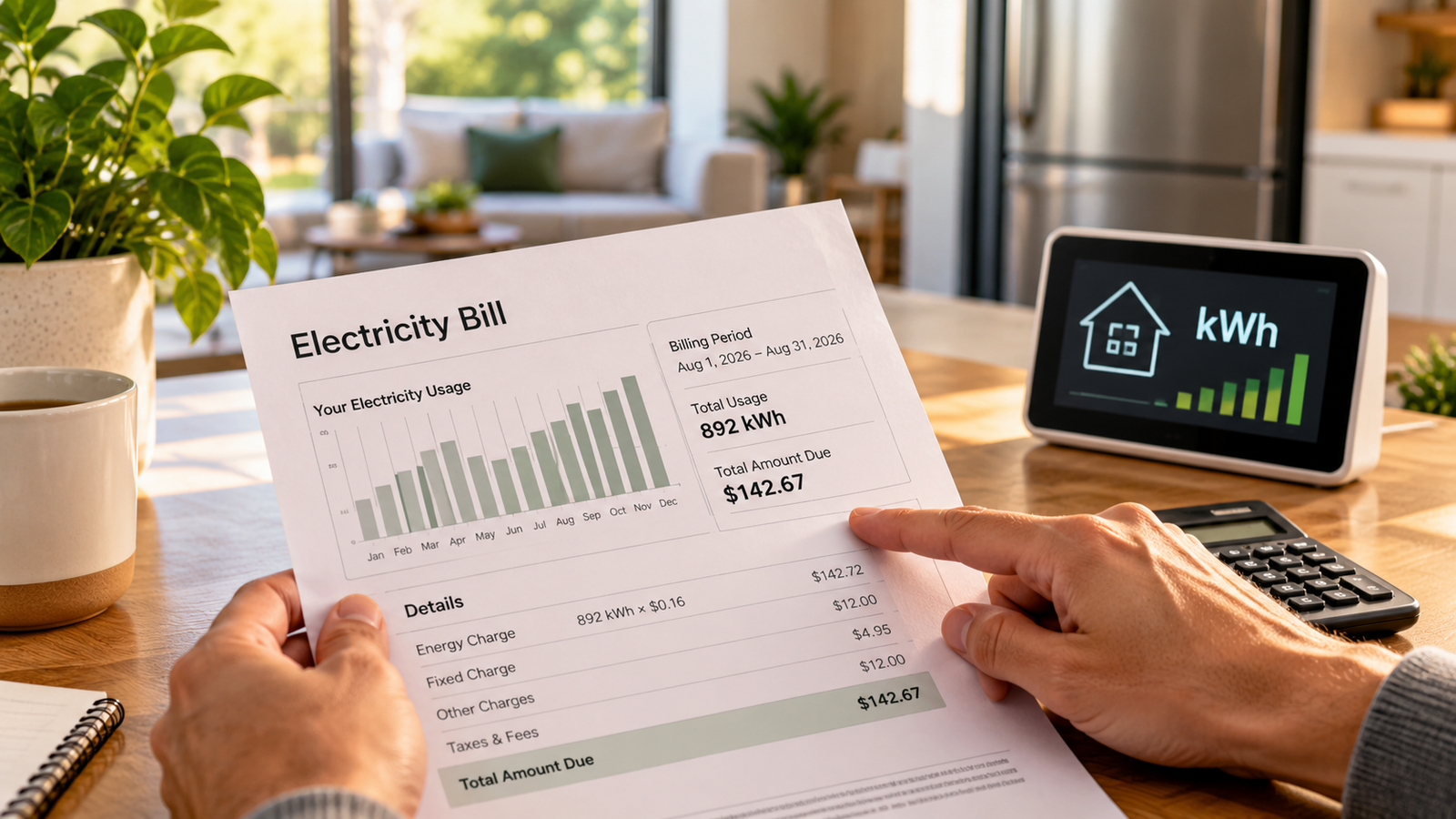
A kilowatt-hour (kWh) is a unit of energy: 1 kilowatt of power used for 1 hour. Your electric meter tracks the energy your home uses over time, and your utility typically bills that consumption in kWh. Once you understand that one number, the rest of an electric bill becomes much easier to decode.
kW vs. kWh: kW measures how quickly electricity is used; kWh measures how much energy is used over time. To estimate energy cost, multiply kWh by the electricity rate on your bill. For example, 100 kWh at a hypothetical $0.18/kWh costs $18 in usage charges before taxes and other fees.
Reading your meter or bill? Your bill’s total kWh tells you the electricity used during the billing period; a meter reading is a cumulative register value. When a bill shows comparable previous and current actual readings, the difference may give the period’s use, subject to any meter multiplier or utility adjustments. Some smart-meter bills show usage directly instead. Always follow the labels and units on your utility bill.
Quick example: A 1,000-watt appliance running for one hour uses 1 kWh. At a hypothetical rate of $0.18 per kWh, that energy costs $0.18 before fixed charges and taxes. Estimate a particular appliance with the BoodBill Electricity Cost Calculator, or see how to investigate a suddenly high electric bill.
What does kWh mean?
The U.S. Energy Information Administration (EIA) defines a kilowatt-hour as the energy used when 1 kilowatt (1,000 watts) of power is used for 1 hour. Watts and kilowatts describe power at a moment in time; watt-hours and kilowatt-hours describe energy used over time.
- 1 kilowatt (kW) = 1,000 watts (W)
- 1 kilowatt-hour (kWh) = 1 kW used for 1 hour
- 500 watts used for 2 hours = 1 kWh
- 100 watts used for 10 hours = 1 kWh
That distinction matters because your bill is based primarily on energy consumption, not simply the wattage printed on an appliance.
Source: U.S. Energy Information Administration — Measuring electricity.
kW vs. kWh: the easiest way to think about it
Think of kW as the rate at which a device is using electricity and kWh as the amount accumulated over time.
A 1,500-watt space heater, for example, has a power rating of 1.5 kW. If it draws that full power for one hour, it uses 1.5 kWh. If it does so for four hours, the simple energy calculation is 6 kWh.
If you want to see that calculation translated into dollars, read our space heater running-cost guide.
How to calculate kWh from watts
For a device with reasonably steady power draw, use this basic formula:
kWh = watts × hours used ÷ 1,000
Example: suppose a 1,000-watt device runs for 3 hours.
- 1,000 watts × 3 hours = 3,000 watt-hours
- 3,000 ÷ 1,000 = 3 kWh
Real appliances often cycle on and off or vary their power draw, so nameplate wattage multiplied by time is not always a precise measurement of actual consumption. For appliances with an EnergyGuide label, the label’s annual kWh estimate can be a better starting point. The Federal Trade Commission says EnergyGuide labels help consumers compare energy use among similar models, while the dollar operating-cost estimate depends on assumed use and energy prices.
Source: Federal Trade Commission — How to Use the EnergyGuide Label.
How to convert kWh into dollars
Once you know the kWh, the basic energy-cost calculation is:
Energy cost = kWh used × electricity rate per kWh
For example, at $0.18 per kWh, 100 kWh of energy would correspond to $18 in usage cost before considering other bill components.
That $0.18 figure is only a simple example. Electricity prices vary substantially by state, utility, rate plan, and time period. For context, EIA reported a U.S. residential average price of 18.31 cents per kWh for July 2026, released September 24, 2026. State residential averages for that same month ranged widely, so your own bill’s rate is the number that matters for household calculations.
Source: EIA Electric Power Monthly, Table 5.6.A — July 2026.
How to read the important numbers on your electric bill
Electric bills do not all use the same layout or terminology. Utilities and states have different rate structures and charges. But these are the fields worth finding first.
1. Billing period
Check the start and end dates before comparing one bill with another. A bill covering more days can be higher even if your average daily electricity use did not change.
2. Electricity usage in kWh
This is one of the most useful numbers on the bill. It tells you how much metered electricity was attributed to the billing period. EIA notes that utilities use electricity meters to measure customer consumption, with many utilities now using electronic smart meters.
3. Your rate or energy charges
Look for the price applied to electricity use. Depending on your utility and rate plan, you may see one rate, multiple tiers, time-of-use prices, or separate supply and delivery-related charges. Do not assume that dividing the total bill by kWh reveals a universal ‘electricity rate’ because the total can include fixed fees, taxes, credits, and other charges.
4. Fixed and other charges
Some bill components do not rise and fall in direct proportion to your kWh. This is why reducing consumption by 10% does not necessarily reduce the final bill by exactly 10%. Read the labels on your own utility bill rather than assuming every charge is usage-based.
5. Previous and current meter readings
If your bill shows meter readings, they help explain how the utility arrived at the billed consumption. Some bills may also identify whether a reading was actual or estimated. Terminology varies by utility.
A simple example electric bill
Imagine a household used 850 kWh during a 30-day billing period and, purely for illustration, the applicable energy price were $0.18 per kWh.
- Usage: 850 kWh
- Illustrative energy rate: $0.18/kWh
- Usage-based energy calculation: 850 × $0.18 = $153
The final bill could be higher or lower than $153 because the actual tariff may include fixed customer charges, different rate components, taxes, credits, tiered pricing, time-of-use pricing, or other adjustments. The example is meant to show the kWh calculation, not reproduce a specific utility tariff.
How much electricity does a typical U.S. home use?
There is no single ‘normal’ number for every home. EIA notes that electricity consumption varies widely by region and housing type. Its residential overview says the average U.S. household consumes about 10,500 kWh per year, while homes in different regions and building types can be far above or below that figure.
That makes your own history more useful than a national average when you are trying to spot a problem. Compare your current kWh with the same season last year when possible, and account for differences in billing days, weather, occupancy, and major equipment use.
Source: EIA — Electricity use in homes.
Why your bill can rise even when kWh does not rise much
Your bill is affected by both how much electricity you use and what you are charged for it. A higher rate or a change in other bill components can increase the total even if consumption is fairly stable. Conversely, a large jump in kWh usually points toward increased electricity use somewhere in the home.
If your bill jumped unexpectedly, use our guide to track down why your electric bill increased.
How to use kWh to find expensive appliances
Once you understand kWh, appliance costs become easier to compare. Estimate or measure energy use, then multiply it by your own electricity rate. You can enter those values into the BoodBill Electricity Cost Calculator to estimate operating costs for different appliances.
For refrigerators, for example, annual kWh from the EnergyGuide label is more useful than assuming the compressor runs at full rated wattage all day. Our refrigerator running-cost guide shows that method step by step.
Quick checklist: read your bill in five minutes
- Check the billing dates and number of days.
- Find total electricity use in kWh.
- Compare kWh with the previous month and, preferably, the same season last year.
- Find the rate or rate components applied to your usage.
- Separate usage-based costs from fixed fees, taxes, credits, and other charges shown by your utility.
If you do those five things, you can usually tell whether a higher bill is primarily an energy-use problem, a price/charge problem, or a combination of both.
To put kWh into practice, compare the electricity used by a dishwasher with the running cost of a heat pump dryer versus a conventional electric dryer. Both guides explain how appliance-specific energy use and your electricity rate affect operating cost.
Bottom line
A kWh measures electricity used over time. Your utility meter tracks that consumption, and your bill converts it into charges under your rate plan. Start with the billing period, total kWh, and the rates or charges applied to that usage. Those numbers give you a much clearer picture than looking at the final dollar amount alone.
Last updated: October 21, 2026. BoodBill provides general educational information; utility tariffs and bill formats vary by provider and location.