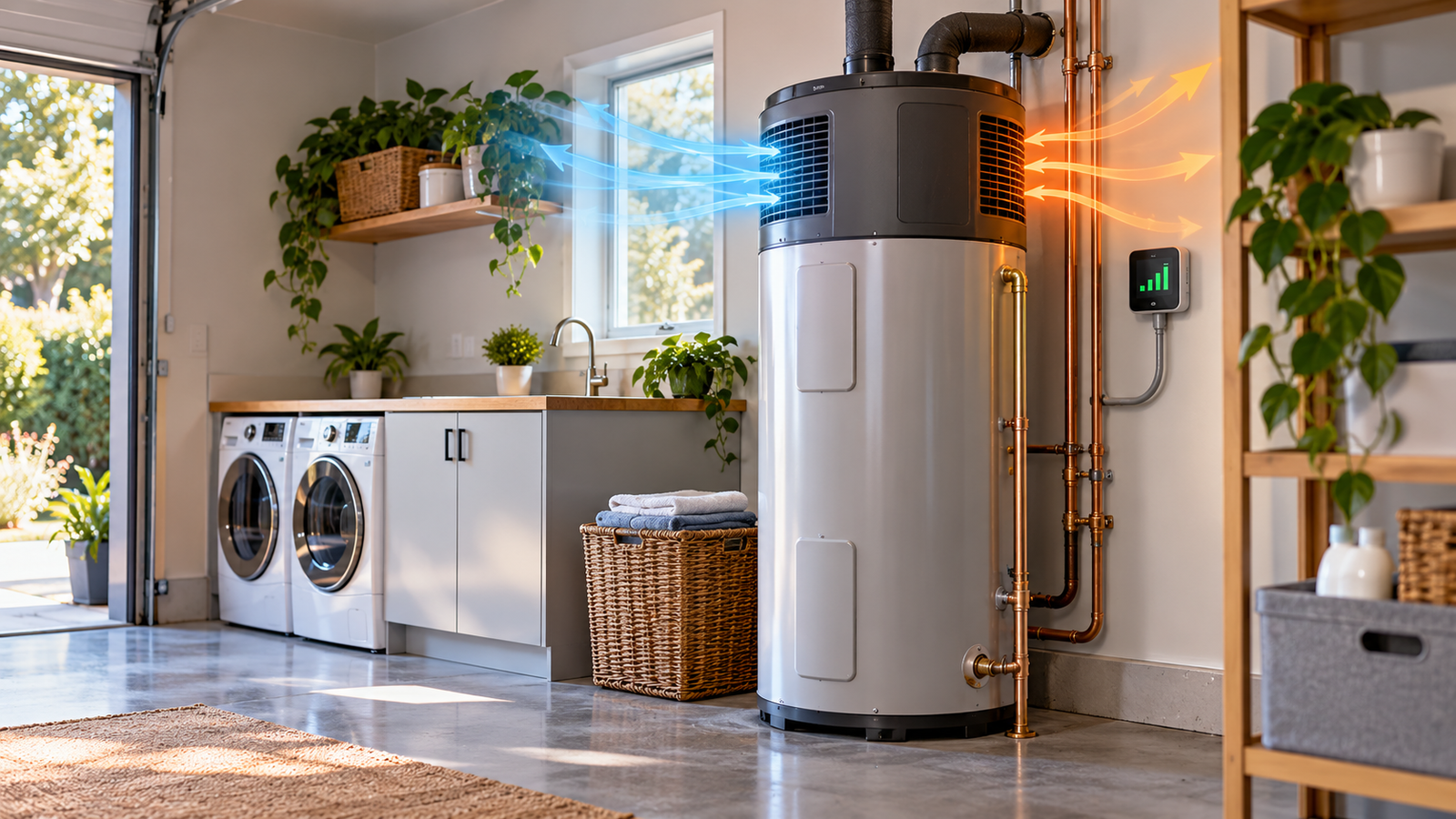
Quick answer: A heat pump water heater can use substantially less electricity than a conventional electric-resistance tank because it moves heat from the surrounding air into the water instead of creating most of that heat directly with resistance elements. The U.S. Department of Energy says heat pump water heaters can be two to three times more energy efficient than conventional electric-resistance water heaters. Whether the upgrade is worth it for you still depends on purchase and installation cost, household hot-water use, electricity price, available space, climate, and where the unit will be installed.
This is exactly the kind of upgrade where “more efficient” and “better financial decision” are related but not identical. Below, we separate the energy question from the payback question.
Heat pump vs standard electric water heater
| Factor | Heat pump water heater | Standard electric resistance tank |
|---|---|---|
| How it heats water | Moves heat from surrounding air into the tank; typically includes resistance backup | Uses electric resistance elements to create heat |
| Electricity use | Usually lower for the same hot-water service | Usually higher |
| Upfront cost | Typically higher | Typically lower |
| Installation | Needs suitable air volume, temperature conditions, drainage and clearance | Generally simpler replacement when an electric tank already exists |
| Side effect | Can cool and dehumidify the surrounding space | No comparable heat-pump cooling effect |
| Best case | Higher hot-water use, suitable location, high electricity costs, long ownership horizon | Low upfront budget, constrained installation space, or low hot-water use |
Why a heat pump water heater uses less electricity
A conventional electric tank passes current through resistance heating elements. A heat pump water heater instead uses a refrigeration cycle to capture heat from the air and transfer it into the tank. Because it is moving heat rather than producing all of it through resistance, it can deliver more heat to the water per unit of purchased electricity.
DOE describes heat pump water heaters as two to three times more energy efficient than conventional electric-resistance models. That does not mean every household will cut its total electricity bill by two-thirds: water heating is only one part of the bill, and real savings depend on usage, operating mode, installation conditions and the models being compared.
If the difference between kW and kWh is unclear, start with our guide to what a kWh means on your electric bill.
How to compare operating cost correctly
The most useful comparison uses the annual energy-consumption estimate on the EnergyGuide label or manufacturer documentation for the specific models you are considering.
Annual operating cost = annual kWh × your electricity price per kWh
For example, suppose two candidate water heaters list 900 kWh/year and 2,800 kWh/year. At 18.31¢/kWh, the arithmetic would be about $165/year versus $513/year, a difference of roughly $348/year.
Those kWh figures are illustrative assumptions, not BoodBill claims about typical products. The 18.31¢/kWh rate is the U.S. residential average reported by the U.S. Energy Information Administration for July 2026. For a purchase decision, use the annual kWh figures for the actual models and the electricity rate on your own bill.
Water Heater Savings & Payback Calculator
Compare a heat pump water heater with a standard electric model using annual kWh, your electricity rate, and the extra installed cost.
Use actual model EnergyGuide figures and installed-price quotes. Simple payback does not include incentives, financing, maintenance, future energy prices, or equipment life.
Calculate the simple payback
Once you have an annual operating-cost difference, you can make a basic payback estimate:
Simple payback = extra installed cost ÷ estimated annual savings
If a heat pump model costs $1,500 more installed and your estimated electricity savings are $350 per year, the simple payback is about 4.3 years.
That is only a screening calculation. It does not account for financing, maintenance differences, future electricity prices, equipment life, changes in household size, or the time value of money. It is still much more useful than buying solely because one model has a higher efficiency rating.
Installation can make or break the decision
It needs air to pull heat from
A heat pump water heater interacts with the room around it. DOE notes that these systems should be installed in locations that remain within the manufacturer’s required temperature range and provide enough air space. A cramped closet may require ducting or may not be appropriate for a particular model.
It produces cool, dehumidified air
Because the unit extracts heat from surrounding air, its exhaust is cooler and drier. That can be useful in a warm basement or garage, but less attractive if the unit sits inside conditioned space where your heating system must replace some of that heat during winter.
Condensate needs somewhere to go
Like an air conditioner or dehumidifier, the heat-pump process can produce condensate. The installation therefore needs an appropriate drainage solution according to the manufacturer’s instructions and local code.
Noise and clearance matter
Heat pump water heaters include a compressor and fan. Check the specific model’s sound rating and required service clearances before choosing a location next to bedrooms or living areas.
What is UEF?
Water heaters use an efficiency metric called Uniform Energy Factor (UEF). In general, a higher UEF indicates greater water-heating efficiency within the applicable product category and draw pattern. Use the EnergyGuide label and model-specific documentation rather than comparing one marketing number in isolation.
Capacity also matters. A highly efficient water heater that cannot meet your household’s peak hot-water demand is not a good match.
What happens when hot-water demand is high?
Many heat pump water heaters are hybrid units: they combine the heat pump with electric resistance elements. Different operating modes can prioritize efficiency, recovery speed, or a combination of the two. During periods of heavy hot-water demand, resistance backup may operate, which can increase electricity use compared with heat-pump-only operation.
That is one reason model size and household usage pattern matter. A family with back-to-back showers has a different load profile from a one-person household.
When a heat pump water heater is more likely to make sense
- You are already replacing an electric-resistance water heater.
- Your household uses a meaningful amount of hot water.
- Your electricity rate makes efficiency valuable.
- You have an installation location with adequate space and suitable temperatures.
- You expect to remain in the home long enough to recover the higher upfront cost.
- The installed price difference is reasonable after any incentives actually available to you.
When a standard electric tank may still make sense
- The upfront budget is the overriding constraint.
- The available location cannot meet the heat pump model’s installation requirements.
- Hot-water use is very low, reducing the dollar value of efficiency savings.
- The added installation work makes the price premium too large to recover within your ownership horizon.
- Noise or cooling of the installation space would create a real comfort problem.
Do not assume an old tax credit is still available
Incentives can materially change payback, but they also change over time and can depend on eligibility, location and installation date. Do not build a purchase decision around an old article quoting a federal credit or rebate without checking the current program rules. BoodBill treats incentives separately from the underlying energy economics for exactly that reason.
Heat pump water heater vs gas
This article focuses on replacing or comparing electric water heaters. Comparing a heat pump water heater with natural gas requires additional inputs: local gas price, gas equipment efficiency, venting, fixed utility charges, installation work, and local electricity price. A lower kWh figure alone cannot answer that comparison.
Could your water heater be behind a high electric bill?
Yes. Electric water heating can be a substantial household load, and unusually high hot-water use or an equipment problem can increase consumption. If your entire bill has jumped rather than gradually changed, work through our high electric bill troubleshooting guide instead of assuming the water heater is automatically responsible.
How this compares with other large electrical loads
Water heating is only one part of home energy use. In hot weather, cooling can also be a major load. If you are trying to understand where your electricity goes, compare this guide with our breakdown of central air-conditioner electricity use and window AC electricity use.
Frequently asked questions
Does a heat pump water heater really save electricity?
Compared with conventional electric resistance water heating, it can. DOE says heat pump water heaters can be two to three times more energy efficient. Actual household kWh savings depend on the specific models, hot-water demand, operating mode and installation environment.
Is a heat pump water heater worth the higher price?
It can be, but calculate it. Compare the extra installed cost with the estimated annual electricity savings using model-specific EnergyGuide data and your own electricity rate. A high efficiency rating by itself does not guarantee a good payback.
Will it make my basement cold?
It removes heat from the surrounding air and exhausts cooler air, so it can cool the installation space. How noticeable that is depends on the room, climate, equipment, ducting configuration and how much the unit operates.
Does it work in a garage?
Potentially, if the garage stays within the model’s permitted operating-temperature range and meets its air-volume, clearance, drainage and other installation requirements. Check the manufacturer’s instructions for the specific unit.
Does a heat pump water heater run all the time?
No universal runtime applies. It responds to tank temperature and hot-water demand, and operating behavior differs by model and mode.
The bottom line
A heat pump water heater can dramatically reduce the electricity needed for water heating compared with a conventional electric-resistance tank, but the smartest purchase decision comes from the numbers for your home.
Compare model-specific annual kWh, multiply by your electricity rate, calculate the annual dollar difference, then compare that with the extra installed cost. Finally, make sure the installation location actually suits heat-pump equipment. That gives you a defensible answer to “is it worth it?” rather than a generic yes.
You can also use the BoodBill electricity cost calculator for measured or annual kWh.
Sources
- U.S. Department of Energy — Heat Pump Water Heaters (accessed October 6, 2026).
- ENERGY STAR — Heat Pump Water Heaters (accessed October 6, 2026).
- U.S. Energy Information Administration — Electric Power Monthly (accessed October 6, 2026).
Example costs are BoodBill calculations from explicitly stated assumptions and are for general information only. Where an article labels consumption figures as hypothetical or illustrative, they are not claims about typical model consumption.