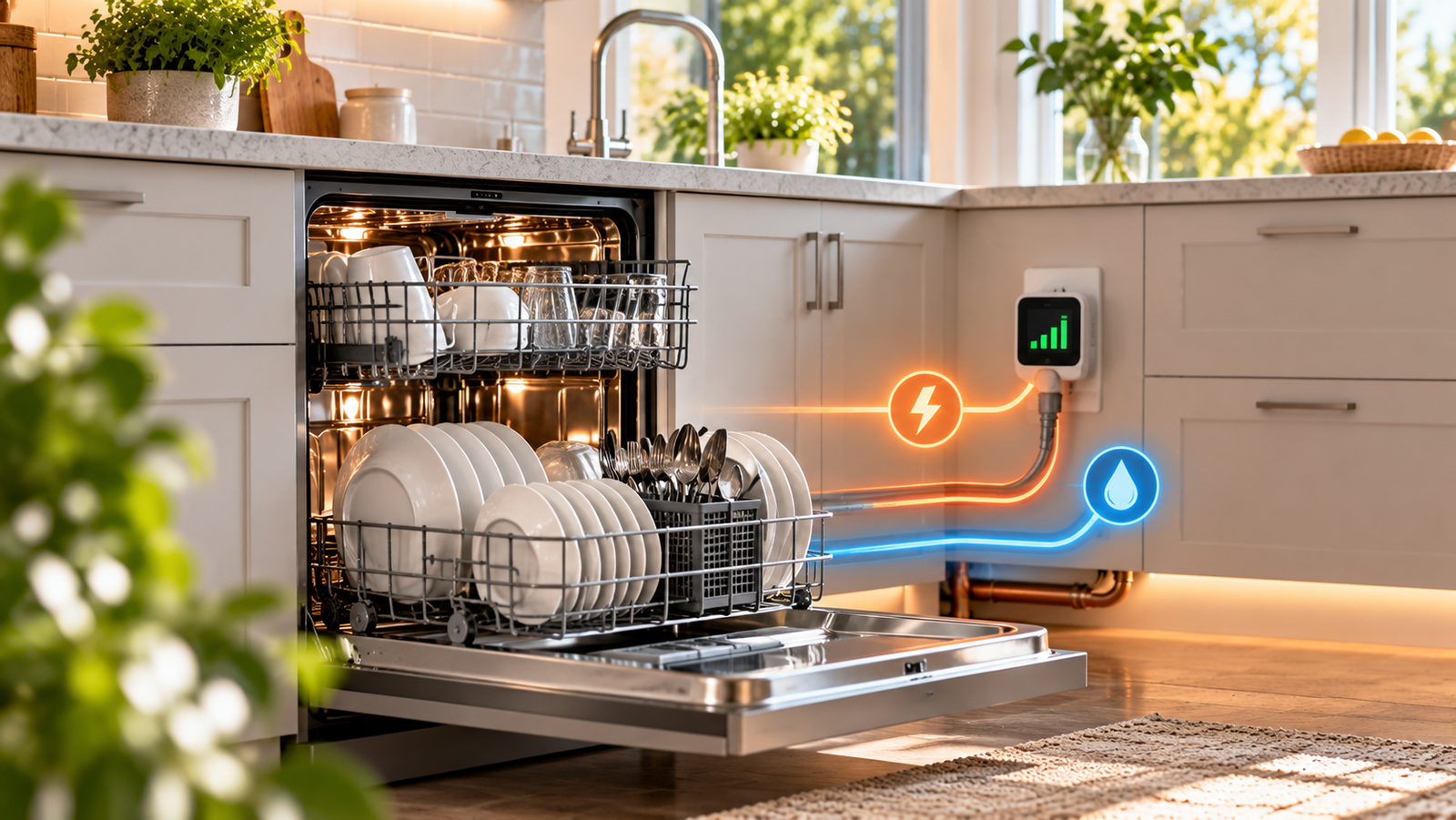
Quick answer: A dishwasher’s electricity use varies by model and cycle, so its rated wattage alone cannot tell you the cost of a full wash. Pumps, water heating, controls and optional heated drying draw power at different times. Check the model’s EnergyGuide annual kWh figure or documented cycle consumption for a useful estimate.
How much does one cycle cost? Multiply kWh per cycle by your electricity rate. For example, a hypothetical 1.0 kWh cycle at $0.18/kWh costs $0.18 in direct electricity; 20 cycles would cost $3.60. This is an arithmetic example, not a claim about typical dishwasher consumption. Household hot-water heating may add energy cost beyond the dishwasher’s measured electricity.
Dishwasher vs washing by hand: A full, efficient dishwasher can use less water and water-heating energy than washing dishes under a continuously running hot-water tap. Washing carefully in a filled basin is a different comparison. Compare the two methods.
How to calculate dishwasher electricity cost
If you know the dishwasher’s electricity consumption per cycle, the basic calculation is straightforward:
Electricity cost per cycle = kWh per cycle × electricity price per kWh
Then:
Monthly dishwasher electricity cost = cost per cycle × cycles per month
Using the hypothetical example above, 1.0 kWh per cycle at $0.18/kWh costs $0.18 per cycle, or $3.60 for 20 cycles in direct electricity. These values illustrate the calculation only; they are not a typical-model estimate or a fixed U.S. electricity rate. Use your actual model’s energy data and your own utility rate.
BoodBill Energy Tools
Dishwasher electricity cost
Use kWh for your usual cycle, including the drying option you select.
Cycle consumption varies with settings. Check whether your estimate includes water-heating energy.
How we calculated this
All periods use a 365.25-day year: 365.25 ÷ 7 weeks and 12 average months. Daily and weekly figures are averages, including days the appliance is not used.
Estimates cover electricity operating costs only. They do not model time-of-use pricing, demand charges, tiered rates, or changes in behavior and weather.
Private by design: calculations stay in this page. No account, storage, or external calculation service.
If kWh is unfamiliar, start with our guide to what a kWh means and how to read it on your electric bill.
Why dishwasher energy use is more complicated than its wattage
A dishwasher does not normally draw one fixed wattage for an entire cycle. Different components operate at different times. The circulation pump may run while washing, an electric heating element may operate during portions of the cycle, controls use a smaller amount of power, and drying behavior varies by model and selected option.
That is why multiplying a single nameplate wattage by the full cycle length can produce a poor estimate. Model-specific annual energy consumption or standardized energy-label data are usually more useful for comparing machines.
Hot water is part of the equation
Dishwashers need hot water, and heating water requires energy. Some of that energy can be supplied by the household water heater before water enters the dishwasher, while the dishwasher may add heat during the cycle.
This matters because the total household cost can depend on what heats your water. A home with an electric-resistance tank, a heat pump water heater, or a gas water heater can have different energy costs even when the dishwasher itself is identical.
For this reason, BoodBill separates direct dishwasher electricity from the broader energy cost of supplying hot water instead of pretending they are always the same number.
What affects dishwasher electricity use?
Cycle selection
Heavy, sanitize, high-temperature, or other intensive programs can use energy differently from normal or eco-oriented cycles. The exact behavior depends on the model, so check the manufacturer’s cycle documentation rather than assuming every “eco” or “heavy” mode behaves identically.
Heated drying
Drying options can change electricity use. If your dishwasher offers an energy-saving or air-dry option, it may reduce the amount of active heating used for drying, though results and cycle behavior vary by machine.
How full the dishwasher is
Running many lightly loaded cycles can use more energy and water per dish than waiting for a full load, provided dishes are loaded in a way that still allows proper cleaning.
Water-heating efficiency
Because hot water is part of dishwashing, a more efficient household water-heating system can reduce the broader energy cost associated with the task. This is especially relevant when evaluating appliances as part of the whole home’s energy use rather than as isolated devices.
Model efficiency
ENERGY STAR-certified dishwashers must meet efficiency criteria for energy and water use. When comparing replacements, use the current EnergyGuide label and ENERGY STAR information for the specific models rather than relying on a generic dishwasher average.
Dishwasher vs hand washing: which uses less energy and hot water?
Quick comparison: For a full load of dishes, a modern ENERGY STAR certified dishwasher will often use less water and water-heating energy than washing the same dishes under a continuously running hot-water faucet. But washing efficiently in a filled sink or basin is a different comparison. The outcome depends on how much hot water you use, your water heater, dishwasher model, and cycle settings.
Dishwasher vs running hot water at the sink
A running hot-water tap consumes heated water throughout the washing and rinsing process. A dishwasher instead uses a measured amount of water per cycle, recirculates it during washing, and uses electricity for pumps, controls, heating, and potentially heated drying. That is why comparing only the dishwasher’s electrical wattage with the electricity used at the sink misses much of the energy picture: heating the sink water also takes energy, even if that consumption is recorded at a separate water heater.
Under the current ENERGY STAR dishwasher criteria, a qualifying standard-size model is limited to 3.2 gallons of water per cycle and 240 kWh of annual energy use under the specified test method. These are certification thresholds, not measured consumption for every model or cycle, and should not be compared with hand washing without measuring the water used at the sink.
What if you wash dishes in a filled basin?
Efficient hand washing with a small amount of heated water can use much less water than leaving the faucet running. There is no reliable universal savings percentage for every kitchen. A fair comparison must account for the same number of dishes, the volume of hot water used by each method, the energy source and efficiency of the household water heater, and any dishwasher drying heat.
How to compare the two methods in your home
- Measure hot-water use: for hand washing, estimate the gallons of hot water used instead of judging by time alone. If the tap runs, measure its flow rate and the minutes it stays on.
- Look up dishwasher water and energy data: check your model’s EnergyGuide label and manufacturer cycle information. Do not treat the appliance’s instantaneous watts as the energy for a full cycle.
- Include the water heater: a gas, resistance-electric, or heat-pump water heater changes the energy and cost of supplying hot water to either method.
- Compare similar loads: use the same quantity of dishes and realistic rinse and drying habits.
For a practical starting point, ENERGY STAR’s dishwasher buying and use guidance recommends scraping rather than pre-rinsing dishes, running full loads when practical, and considering no-heat drying options. These steps help avoid using hot water unnecessarily without promising that one method is cheapest in every home.
How much does a dishwasher cost per month?
Use this four-step method instead of a generic monthly number:
- Find the dishwasher’s annual kWh or cycle-energy information on its EnergyGuide label or manufacturer documentation.
- Use the electricity rate on your utility bill.
- Estimate how often you actually run the dishwasher.
- Remember that household hot-water energy may add cost beyond the dishwasher’s direct electricity consumption.
For annual label data, the arithmetic is:
Annual electricity cost = annual kWh × electricity price per kWh
Divide by 12 only if you want a simple monthly average. Actual monthly use may vary.
Ways to reduce dishwasher energy cost
- Run full loads when practical. Get more dishes cleaned from each cycle without blocking spray arms.
- Choose the appropriate cycle. Do not automatically use the most intensive setting when a normal cycle is sufficient.
- Use energy-saving drying options when they work for you. Check your model’s instructions.
- Do not waste hot water unnecessarily before loading. Follow the dishwasher manufacturer’s guidance on scraping and pre-rinsing.
- Maintain filters and spray components. Poor cleaning performance can lead to unnecessary repeat cycles.
- Compare annual kWh when replacing the appliance. Upfront price is only one part of ownership cost.
Should you replace an old dishwasher just to save electricity?
Not automatically. A newer efficient dishwasher can use less energy and water, but replacement has an upfront cost. If your current machine works well and your household runs relatively few cycles, energy savings alone may take a long time to recover the purchase price.
If the existing dishwasher is already failing, leaking, cleaning poorly, or nearing replacement anyway, efficiency becomes more useful as a selection criterion because you are already facing a purchase.
The same principle applies to refrigerators. Our guide to refrigerator running cost explains why operating cost matters without assuming every functioning appliance should immediately be replaced.
Could a dishwasher cause a high electric bill?
It contributes to household energy use, but a normal dishwasher is only one load among many. A sudden large increase in the electric bill deserves a broader investigation rather than automatically blaming one appliance.
If your bill changed unexpectedly, work through 9 common causes of a high electric bill and compare current usage with previous billing periods.
Frequently asked questions
Does a dishwasher use a lot of electricity?
Its significance depends on the model, cycle choices, frequency of use, drying settings, and the energy needed for hot water. Use model-specific annual kWh or cycle data to judge your appliance.
Is it cheaper to run a dishwasher at night?
Only if your electricity tariff changes by time of day. Some utilities use time-of-use pricing while others do not. Check your rate plan rather than assuming nighttime electricity is cheaper.
Does turning off heated dry save electricity?
It can reduce active drying energy on machines where that option changes heater operation. The exact saving depends on the dishwasher and cycle, so consult the model documentation.
Should I pre-rinse dishes?
Follow the manufacturer’s guidance. Unnecessary hot-water pre-rinsing can add water-heating energy outside the dishwasher itself.
What is the best way to compare two dishwashers?
Compare capacity, annual energy use, water consumption, features you will actually use, expected reliability and purchase price. The EnergyGuide label and current ENERGY STAR certification are useful starting points for energy comparisons.
The bottom line
A dishwasher’s true household energy cost is more than a single wattage number. Direct electricity use changes through the cycle, and hot-water energy can be supplied partly outside the appliance.
For the most defensible estimate, use the specific model’s annual kWh or cycle data, multiply by your own electricity rate, account for how often you run it, and remember the water-heating side of the equation. That tells you far more than a generic “dishwasher costs X dollars per month” claim.
Use the main electricity cost calculator for other household appliances and devices.
Sources
- ENERGY STAR — Dishwashers (accessed October 6, 2026).
- U.S. Department of Energy — Dishwashers (accessed October 6, 2026).
- U.S. Energy Information Administration — Electric Power Monthly (accessed October 6, 2026).
Example costs are BoodBill calculations from explicitly stated assumptions and are for general information only. Where an article labels consumption figures as hypothetical or illustrative, they are not claims about typical model consumption.