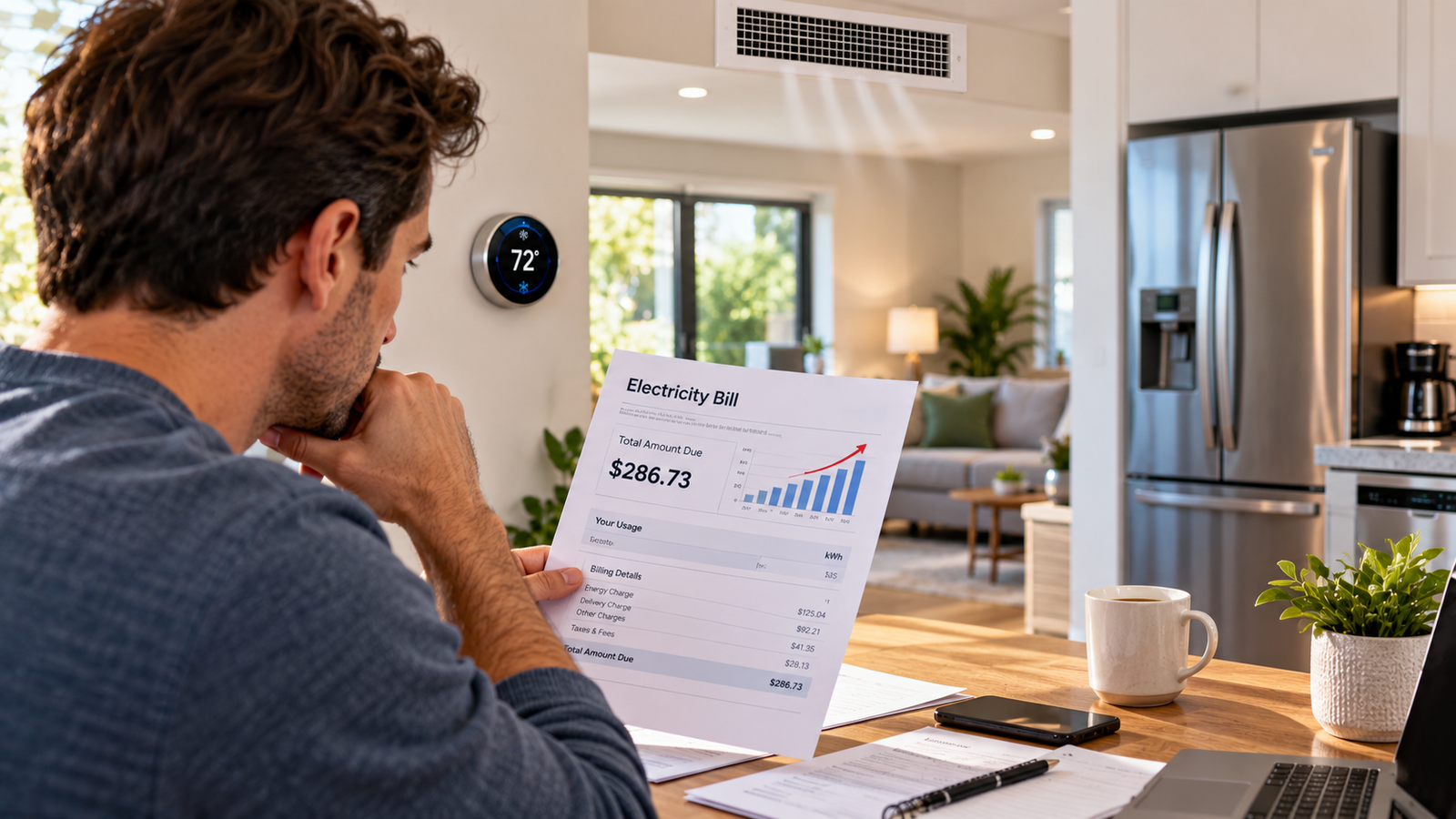
A high electric bill does not automatically mean something in your home is broken. The total can rise because you used more electricity, your utility charged more per kilowatt-hour, the billing period was longer, or several smaller changes happened at the same time.
The fastest way to find the cause is to separate price from usage. Pull out your current bill and a comparable older bill, then compare the number of kilowatt-hours (kWh), the billing dates, and the rate or charges. If you are not comfortable reading those numbers yet, start with our guide to what a kWh is and how to read your electric bill.
Quick diagnosis: If your electric bill suddenly jumped, first compare the kWh used, billing days, and rate or charges on your current and previous bills. More kWh points toward a change in usage, such as heating or cooling. Similar kWh but a higher total points toward pricing or fees. More billing days can increase the total even if daily use is unchanged.
Make a fair comparison: Divide total kWh by the number of billing days to estimate average daily kWh for each bill. This helps distinguish longer billing periods from actual increases in daily consumption. Seasonal weather and changing rate schedules can still affect the comparison.
Not sure where to find those numbers? See our guide to reading electricity bills and kWh. To estimate the operating cost of an appliance, use the BoodBill Electricity Cost Calculator with your own rate and usage assumptions.
First: Did Your Electricity Use Go Up, or Did the Price Go Up?
If your kWh usage is roughly the same as before but the bill is higher, look for a higher electricity rate, fixed charges, taxes, fees, or a different rate plan. Some utilities also use time-of-use rates, where electricity can cost more during peak periods and less off-peak.
If your kWh usage increased substantially, the next step is to figure out what changed in the home. Heating and cooling are a good place to start: the U.S. Energy Information Administration says they are the largest annual residential electricity uses, and their consumption changes with the weather.
1. Hotter or Colder Weather
A heat wave or cold spell can increase electricity use even when you have not consciously changed your routine. Air conditioners and electric heating systems simply have to run longer to maintain the same indoor temperature.
This is why comparing July with April can be misleading. A better comparison is the same month last year, while remembering that weather can still differ from one year to the next.
2. Your HVAC System Is Working Harder Than It Should
A dirty filter can restrict airflow and make heating or cooling equipment work harder. ENERGY STAR recommends checking the filter monthly during heavy-use seasons and changing it when dirty; at minimum, it recommends replacement every three months.
Also check whether vents are blocked, the thermostat is set differently than usual, or the system seems to run for unusually long periods. More serious problems—such as refrigerant, electrical, or equipment faults—are better handled by a qualified HVAC professional.
3. Air Leaks or Duct Losses Are Wasting Conditioned Air
Gaps around doors, windows and other penetrations let outdoor air enter while conditioned air escapes. The Department of Energy notes that air sealing can reduce wasted heating and cooling energy. Ductwork matters too: DOE says a typical house can lose about 20%–30% of the air moving through its duct system because of leaks, holes and poor connections.
If some rooms are difficult to keep comfortable while others are fine, or ducts run through an attic, garage or crawlspace, leakage is worth investigating before assuming you need a larger HVAC system.
4. A Space Heater or Other High-Wattage Device Is Running More
Portable resistance heaters can draw a lot of power while they are on. A common 1,500-watt heater uses 1.5 kWh for every hour it runs at full power. A few extra hours each day can therefore become noticeable on a monthly bill. See our space-heater running-cost guide to calculate the cost using your own electricity rate.
5. An Extra or Aging Refrigerator Is Adding Constant Load
Refrigerators cycle throughout the day, so an inefficient second refrigerator can quietly add to annual electricity use. Garage conditions can make the situation worse when temperatures are far outside normal indoor conditions.
If you want to estimate your kitchen refrigerator first, use our guide to how much it costs to run a refrigerator. If you keep an older second unit in the garage, our garage refrigerator guide explains how to measure its actual consumption.
6. Your Thermostat Schedule Changed
A few degrees for many hours can matter more than people expect because the HVAC system is one of the home’s biggest energy users. The Department of Energy says households can save as much as 10% a year on heating and cooling by turning the thermostat back 7°F–10°F for eight hours a day, where that strategy is appropriate for the system.
If you are considering an upgrade, read our comparison of smart thermostats versus standard models. The right choice depends on your HVAC system and how consistently you would actually use the scheduling features.
7. Your Household Routine Changed
Working from home, school breaks, guests, a new baby, more cooking, extra laundry, a dehumidifier, a pool pump, or charging an electric vehicle at home can all increase electricity use. One change may be modest, but several together can explain a large jump.
8. The Billing Period Is Longer Than Usual
Do not compare only the dollar totals. Check the start and end dates on both bills. A bill covering more days can be higher even if your average daily electricity use did not change much. Divide total kWh by the number of billing days for a cleaner comparison.
9. Your Electricity Rate or Rate Plan Changed
Your home can use the same amount of electricity and still receive a higher bill when the price of electricity or other charges increase. If your utility uses time-of-use pricing, shifting high-consumption activities away from peak hours may reduce costs even without reducing total kWh.
A Simple 10-Minute High-Bill Check
- Compare current kWh with the same month last year and with the previous bill.
- Compare the number of billing days.
- Check the electricity rate and fixed charges.
- Think about unusually hot or cold weather.
- Check thermostat settings and the HVAC filter.
- List anything new that uses significant electricity: heaters, EV charging, pool equipment, dehumidifiers or extra appliances.
- If your utility provides hourly or daily usage data, look for when the increase began.
When a Home Energy Audit Makes Sense
If your usage remains unusually high and you cannot identify the cause, a home energy assessment can help find air leaks, insulation problems and inefficient systems. DOE also recommends targeting the largest energy consumer or largest bill first rather than replacing appliances at random.
The Bottom Line
When your electric bill jumps, start with the bill itself before buying anything. Determine whether the increase came from more kWh, a higher price, more billing days, or a combination. Then investigate the biggest loads—especially heating and cooling—and work down from there. That approach is faster, cheaper and more reliable than guessing which appliance is responsible.