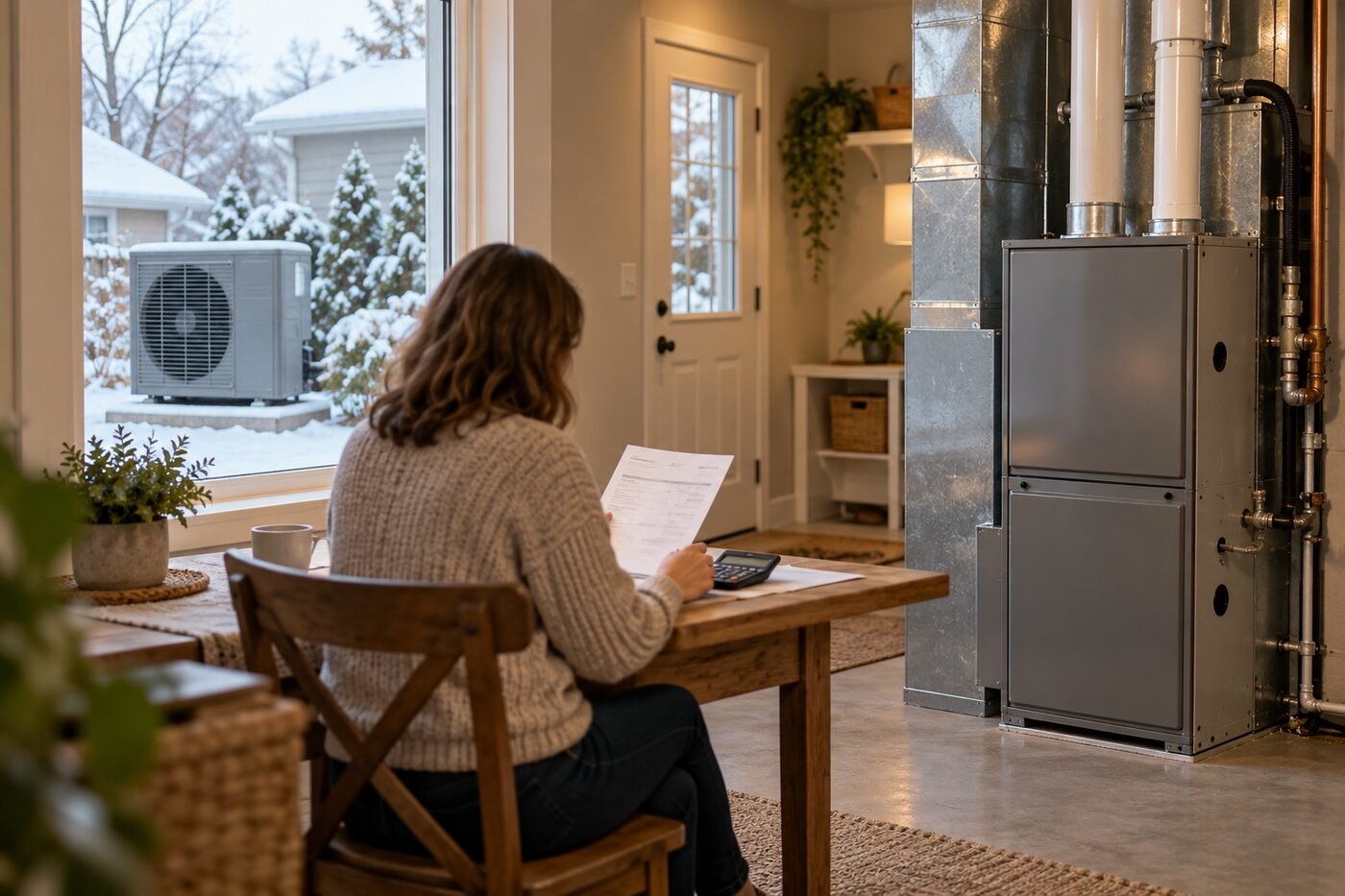
Which costs less to heat a home: an electric heat pump or a natural-gas furnace? There is no single answer for every household. The result depends on local energy prices, seasonal equipment performance, the amount of heat your home needs, and how the system handles cold weather.
This guide compares the two systems for the 2026–27 heating season using transparent formulas and your own utility rates. The example numbers are hypothetical; they are not national averages or a prediction of your bill.
Heat Pump vs. Gas Furnace Cost Calculator
Choose Quick Estimate to start with therms from a natural-gas bill, or Advanced Estimate if you already know the useful heat demand in MMBtu. Enter your own rates and equipment ratings. The calculator estimates variable energy charges for the period represented by your inputs; it does not estimate equipment or installation costs.
BoodBill Energy Tools
Estimate your heating costs
Compare the energy cost of delivering the same amount of useful heat with an electric heat pump or a natural-gas furnace. Enter prices and equipment performance from your own bills and equipment labels. No values are prefilled.
Quick estimate for your selected period
Break-even energy prices
—
Prices that make the variable energy costs equal for this same inferred heating load, holding other inputs constant.
Quick Estimate assumptions
Heating therms = total gas therms − non-heating baseline therms. Estimated useful heat = heating therms × 0.1 MMBtu/therm × AFUE. The calculator then compares the inferred useful heat using the entered heat-pump rating.
This is an estimate based on your gas bill, not a heat-loss calculation. It does not model weather normalization, changing efficiency at low outdoor temperatures, fixed bill fees, or the exact hours when electric resistance backup runs. Use comparable billing periods and adjust the non-heating baseline for water heating and cooking.
Estimated cost for your selected period
Break-even energy prices
—
At the break-even price, estimated variable energy costs are equal for the two systems, holding your other inputs constant.
How the estimate works
Both systems are compared on the same useful heat delivered to the home. The heat-pump calculation converts that heat to electricity using COP. The furnace calculation divides useful heat by AFUE to estimate gas input.
Show formulas and unit conversions
1 kWh = 3,412 Btu; 1 therm = 100,000 Btu; 1 MMBtu = 1,000,000 Btu.
Heat-pump kWh = useful heat (MMBtu) × 1,000,000 ÷ 3,412 × [(1 − backup share) ÷ COP + backup share].
Heat-pump cost = heat-pump kWh × electricity price ($/kWh).
Gas therms = useful heat (MMBtu) × 10 ÷ AFUE fraction.
Gas cost = gas therms × gas price ($/therm).
Break-even electricity price = gas cost per MMBtu ÷ heat-pump kWh per MMBtu.
Break-even gas price = heat-pump cost per MMBtu ÷ gas therms per MMBtu.
For HSPF2 input, the calculator converts the rating to a standardized seasonal COP as HSPF2 ÷ 3.412. HSPF2 is measured in Btu per Wh; COP is a ratio of heat output to electrical energy input.
Assumptions and limits
This estimates variable energy cost only. It excludes equipment purchase and installation, maintenance, cooling benefits, fixed gas charges, taxes not reflected in your entered prices, and time-of-use or tiered-rate effects.
Heat-pump efficiency changes with outdoor temperature and equipment. A resistance-backup share can increase electricity use; if your seasonal COP already includes that backup energy, leave the backup share at 0 to avoid counting it twice. HSPF2 is a standardized rating and may not match your climate, ductwork, controls, or household.
The estimate depends on your inputs. EIA average state prices are reference averages, not your utility’s tariff; use bill prices when available.
Technical sources
- U.S. Department of Energy: Heat Pump Systems
- ENERGY STAR: Heat-pump criteria and HSPF2/COP definitions
- ENERGY STAR: Furnace efficiency criteria
- DOE FEMP: AFUE definition and furnace energy use
- EIA: Btu, kWh, and therm conversions
- EIA: Average residential electricity prices by state
- EIA: Residential natural-gas price data
How the Heating-Cost Comparison Works
Both systems must be compared for the same useful heat delivered to the home and the same period. The U.S. Energy Information Administration (EIA) lists the energy conversions used here: 1 kilowatt-hour (kWh) is about 3,412 Btu, 1 therm is 100,000 Btu, and 1 MMBtu is 1,000,000 Btu. That means 1 MMBtu equals 10 therms of fuel energy. See the EIA unit-conversion reference.
Heat-pump electricity use and cost
For a heat pump with seasonal coefficient of performance (COP), estimated electricity use is:
Heat-pump kWh = Q × 1,000,000 ÷ 3,412 × [(1 − r) ÷ COP + r]
Heat-pump energy cost = heat-pump kWh × electricity price ($/kWh)
Here, Q is useful heat in MMBtu and r is the share of delivered heat supplied by electric-resistance backup, entered as a decimal. The formula treats resistance heat as COP 1. If your seasonal performance value already includes backup electricity, leave the separate backup share at zero to avoid counting it twice.
COP is useful heat output divided by electrical energy input using consistent energy units. HSPF2 is a standardized seasonal rating expressed in Btu per watt-hour for Region IV. It represents heat-pump-system electricity use under test conditions, so do not add a separate resistance-backup share unless the equipment data shows that backup is excluded. Dividing HSPF2 by 3.412 gives a comparable dimensionless seasonal ratio for this estimate, but it does not predict the exact COP in your home. Actual performance depends on the equipment, installation, controls, weather, and backup operation. See ENERGY STAR’s HSPF2 criteria.
Natural-gas furnace use and cost
Enter AFUE as a decimal in the equation below. For example, 95% AFUE is 0.95.
Gas furnace therms = Q × 10 ÷ AFUE
Gas-furnace fuel cost = gas furnace therms × gas price ($/therm)
DOE defines Annual Fuel Utilization Efficiency (AFUE) as useful energy output divided by energy input over the heating season. This comparison estimates fuel cost only; it does not include electricity used by a furnace blower or controls. See the DOE AFUE definition.
Quick Estimate: Use Your Gas Bill to Approximate Heating Demand
If your home currently uses a gas furnace, the Quick Estimate derives a useful-heat estimate from the bill rather than asking you to calculate MMBtu. Subtract estimated non-heating gas use—such as water heating or cooking—from total therms for the same billing period:
Heating therms = total bill therms − non-heating baseline therms
Estimated useful heat (MMBtu) = heating therms × 0.1 × AFUE
For example, 600 therms used for space heating with a 95% AFUE furnace correspond to about 57 MMBtu of useful heat: 600 × 0.1 × 0.95. This is a calculation example, not an assumed value in the calculator. The non-heating baseline is editable; a zero baseline means you are assuming all entered therms were used for space heating. If the bill includes other gas appliances, estimate their use over a comparable period, such as from a warm-weather bill.
This method is not a substitute for a building heat-loss calculation. It can be less representative if the period has unusual weather, the home changed occupancy, the furnace shares heating with another system, or the non-heating baseline is inaccurate. It is intended for homes with gas-use history; do not use total household energy consumption as a heating load without separating other uses.
Worked Example: Same Heating Demand, Different Energy Costs
These are hypothetical inputs used to demonstrate the equations—not typical U.S. rates, equipment averages, or predicted costs. Assume 60 MMBtu of useful heat, electricity at $0.18/kWh, natural gas at $1.50/therm, seasonal COP 3.0, and furnace AFUE 95%.
| Estimate | Heat pump | Gas furnace |
|---|---|---|
| Useful heat | 60 MMBtu | 60 MMBtu |
| Energy use | About 5,861.7 kWh | About 631.6 therms |
| Entered rate | $0.18/kWh | $1.50/therm |
| Estimated variable energy cost | About $1,055.10 | About $947.37 |
With these inputs, the gas furnace’s fuel cost is about $107.73 lower. The result can reverse when rates, seasonal heat-pump performance, backup-heat use, or heating demand change. The comparison excludes fixed monthly fees and the furnace’s electricity use.
Break-Even Electricity and Gas Prices
Break-even prices are the rates at which both systems have the same estimated variable energy cost for the same useful heat. With the other inputs held constant:
- Break-even electricity price ($/kWh) = gas-furnace cost ÷ heat-pump kWh
- Break-even gas price ($/therm) = heat-pump cost ÷ gas-furnace therms
These are operating-cost comparisons, not installation-payback calculations. The result excludes equipment purchase, installation, maintenance, and financing.
Use the variable rates on your own bills when possible. EIA’s residential electricity data and residential natural-gas price data can provide broader context, but published averages are not your utility tariff. Fixed customer charges, time-of-use rates, tiers, taxes, and delivery charges can change your bill.
How Cold Weather and Backup Heat Affect Results
An air-source heat pump’s capacity and efficiency vary with outdoor temperature and the specific equipment. Cold-climate models are designed to operate at lower temperatures, but the right performance values should come from manufacturer data for the model and conditions you are evaluating. DOE notes that some dual-fuel systems switch to a gas furnace in colder weather; other systems may use electric-resistance backup. Either can materially change seasonal energy use. See the DOE heat-pump overview.
When using the calculator, select a seasonal COP when you have one appropriate to the system and climate. If using HSPF2, remember it is a standardized rating, not a measurement of your home’s actual seasonal performance. Do not add a backup share if it is already included in the seasonal figure.
Operating Cost Is Not Total Ownership Cost
A lower estimated heating bill does not necessarily mean a lower lifetime cost. Replacing equipment can involve installation labor, duct changes, electrical upgrades, and other project costs. Maintenance, equipment life, incentives, financing, and whether a heat pump also provides cooling can affect the decision. Compare installation quotes and operating costs separately with qualified local guidance.
Frequently Asked Questions
Is a heat pump always cheaper than natural gas?
No. The result depends on local electricity and gas prices, seasonal heat-pump performance, furnace AFUE, backup operation, and heating demand. Use the same heating period and useful heat when comparing systems.
Does a heat pump work in freezing temperatures?
Many air-source heat pumps can operate below freezing, and cold-climate models are designed for lower outdoor temperatures. Capacity and efficiency still depend on the specific model and conditions; check manufacturer performance data and the system’s backup strategy.
Can I use HSPF2 as my actual seasonal COP?
HSPF2 can be divided by 3.412 to produce a dimensionless rating for an approximate comparison, but it is based on standardized test conditions. Treat it as a rating-based estimate, not a guarantee of real-world COP at your home.
Should I compare total utility bills?
Not by themselves. Total bills may include water heating, cooking, appliances, fixed service fees, and other uses. Compare heating-related consumption and variable rates, and note any costs the calculator excludes.
Related BoodBill Guides
- How to Read kWh on Your Electric Bill
- BoodBill Electricity Cost Calculator
- How Much Does It Cost to Run a Space Heater?
- Smart Thermostats vs. Standard Models
Bottom line: A useful comparison starts with your own energy prices and the same estimated heat delivered to the home. Use the calculator as a transparent operating-cost estimate, then factor in local equipment performance and full project costs before making a system decision.