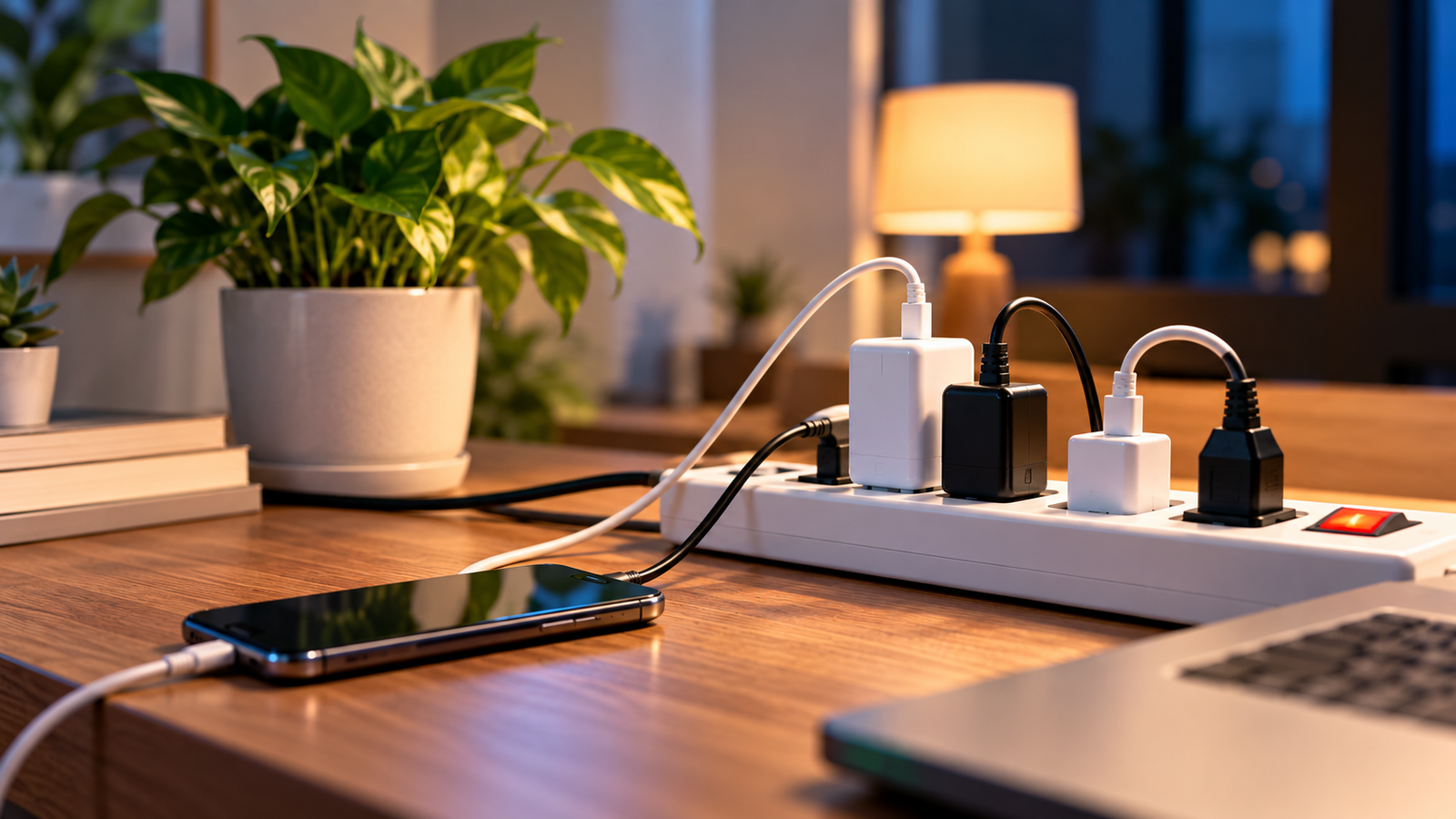
Yes—if a device draws power while it is idle, disconnecting it can stop that standby use. The savings depend on its measured standby watts, how many hours it stays disconnected, how many similar devices you have, and your electricity price. One low-power device may save only a few cents a month; a group of higher-draw devices can add more. Measure first, then decide whether the savings justify the inconvenience.
To calculate the cost of standby electricity, see what a kWh means on your electric bill and use the BoodBill electricity cost calculator with your measured standby power and electricity rate.
In this guide, you’ll learn what standby power is, estimate its cost with your own rate, see which devices may be worth switching off, and identify equipment that should stay connected when its function is needed.
What is standby power?
Lawrence Berkeley National Laboratory (LBNL) describes standby power as electricity used when a product is switched off or not performing its primary function. A device may remain partly active to show a clock, receive a remote-control signal, maintain a network connection, or restart quickly. The display can be dark while some internal circuits are still using power.
“Phantom load” and “vampire power” are common names for this use. They do not mean every plugged-in appliance draws a large amount. Standby consumption differs by model, settings, and operating mode. The U.S. Department of Energy’s measurement guidance explains that low-power measurements should be taken carefully; when a reading fluctuates, measure energy over time and divide by the measurement period to find average power.
Standby power is also different from energy used while an appliance does its main job. A refrigerator’s cooling system cycles to keep food cold; that operating energy is not simply “phantom power.” See our guide to how much a refrigerator costs to run for that separate calculation.
How much can unplugging save?
For a device with an average standby draw that stays about the same, estimate the energy avoided with this formula:
Annual kWh avoided = standby watts × devices × hours disconnected per day × 365 ÷ 1,000
Then estimate the energy-charge savings:
Annual cost avoided = annual kWh avoided × your price per kWh
The latest available U.S. residential benchmark at the time of writing is 18.31 cents per kWh, for July 2026. The EIA table was released September 24, 2026; its July values are preliminary. As the EIA explains in its monthly update, it calculates average revenue per kWh as a proxy for retail prices, so this national figure is not the price on every household’s bill. Use your own bill’s marginal energy rate where possible. The estimate below covers the energy charge only, not fixed fees or other bill items.
Standby electricity savings calculator
Use your measured standby watts, the number of similar devices, the hours per day you can safely disconnect them, and your electricity rate to estimate the energy charges you could avoid. These are estimates, not guaranteed bill savings.
Standby Electricity Savings Calculator
Estimate what unplugging idle electronics could save using your own electricity rate.
Estimates assume constant standby power during disconnected hours, 365 days per year. Actual results vary; fixed utility charges and power-strip consumption are excluded.
Default rate: $0.1831/kWh, based on the preliminary U.S. residential average for July 2026 (EIA); it is not your household tariff.
The examples below are hypothetical calculations, not measurements of specific products. They assume the listed average standby wattage is avoided for the stated hours every day of the year. The 18.31¢ rate is the EIA national residential average; 15¢ and 30¢ are comparison scenarios, not claims about a particular utility tariff. Monthly cost is annual cost divided by 12.
| Example scenario | Energy avoided yearly | At 15¢/kWh | At 18.31¢/kWh | At 30¢/kWh |
|---|---|---|---|---|
| 1 device × 1 W × 8 hours/day | 2.92 kWh | $0.44/year $0.04/month | $0.53/year $0.04/month | $0.88/year $0.07/month |
| 1 device × 5 W × 12 hours/day | 21.90 kWh | $3.29/year $0.27/month | $4.01/year $0.33/month | $6.57/year $0.55/month |
| 3 devices × 5 W each × 12 hours/day | 65.70 kWh | $9.86/year $0.82/month | $12.03/year $1.00/month | $19.71/year $1.64/month |
| 1 device × 10 W × 24 hours/day | 87.60 kWh | $13.14/year $1.10/month | $16.04/year $1.34/month | $26.28/year $2.19/month |
The takeaway is not that a particular household will save one of these amounts. The calculation shows how savings scale with wattage, disconnected hours, device count, and price. For example, three devices at an assumed 5 W each, disconnected 12 hours a day, would avoid an estimated 65.7 kWh per year. At the July 2026 EIA benchmark, that is about $12.03 in energy charges—not $12.03 per device.
Broad claims of a guaranteed annual household saving skip these details. LBNL’s standby-power overview says most products use less than 0.5 W in standby, while estimating that many products together account for 5–10% of residential electricity use. Treat that as broad context from LBNL, not a promise of what your home can save by unplugging devices. Your results depend on the actual appliances and usage. For help with units and bill rates, see what a kWh means and how to read your electric bill.
If you are investigating a high bill, compare kWh usage, billing days, and rates before attributing the change to standby loads. Our guide to common reasons an electric bill can rise walks through that check.
Which devices may be worth switching off?
Potential standby loads include TVs and streaming devices, game consoles in quick-start modes, cable or satellite boxes, DVRs, desktop computers and peripherals, printers, smart speakers, countertop appliances with clocks, and chargers or docking stations. These are examples of product types that may have standby modes—not a ranking and not a claim that every model draws a meaningful amount.
Start with equipment you rarely use and do not need to access remotely. If a plug-in meter confirms a higher average standby draw, consider switching it off during long idle periods. A switched power strip can be convenient for a group of electronics that are used together, such as a TV and its accessories. ENERGY STAR recommends using a power strip as a central “turn off” point and notes that cutting the power supply can eliminate standby consumption for the connected equipment.
Before switching off a device, check its manual and settings. Some electronics need power for scheduled recordings, updates, backups, remote access, or other features. If the device is already in a low-power mode, measure it before deciding that unplugging it is worth the effort.
What should stay connected?
Keep equipment connected when you rely on it to perform a continuous, safety-related, food-preservation, communication, or monitoring function. Examples can include a refrigerator or freezer in use, a modem or router when internet access is needed, smoke or carbon-monoxide alarms, security equipment, a sump pump, or medical equipment. Follow the device’s instructions and do not interrupt a function you depend on.
These items do not all use “standby” power—their electricity may support the service they are meant to provide. Their operating use should be assessed separately from idle electronics. Likewise, unplugging a hot appliance for safety reasons is a separate issue; it does not automatically mean the appliance was using significant standby electricity.
How to measure standby use at home
- Choose the mode you want to check. Test the device when it is off, asleep, or otherwise in the standby state you actually use.
- Use a plug-in power meter suited to low readings. The DOE summary of IEC 62301 says instruments should resolve 0.01 W or less for measurements below 10 W. This is a measurement standard detail, not a claim that every consumer meter meets it.
- Measure long enough. If the power reading varies, record energy over a representative period and divide watt-hours by the number of hours measured to estimate average watts. DOE recommends this approach for fluctuating consumption.
- Enter your actual inputs. Use the average watts, number of devices, hours per day you would disconnect them, and your energy price per kWh. If your tariff changes by time of day or usage tier, a single-rate calculator will only approximate your marginal cost.
- Compare the savings with convenience. Add up the devices you can reasonably switch off. If the estimate is only a few dollars per year, you may prefer to focus effort on larger energy uses such as heating, cooling, or water heating.
A plug-in meter can measure compatible cord-and-plug devices; it may not capture hard-wired equipment. Your utility’s interval data or a qualified electrician may be more appropriate for whole-home or hard-wired measurements.
The bottom line
Does unplugging appliances save electricity? Yes, when they draw standby power—but the bill savings depend on the measured watts, time disconnected, number of devices, and your rate. A few low-draw items may save very little. Measure first, use a switched strip where it makes sense, and keep equipment powered when you rely on its normal or safety function. There is no universal savings percentage that applies to every home.
Frequently asked questions
Do appliances use electricity when they are turned off?
Some do and some do not. Devices with clocks, remote receivers, network connections, or quick-start features may use power in an off or standby mode. The draw varies by product and setting, so a meter or manufacturer specification is more useful than guessing.
How much does 1 watt of standby power cost?
At 18.31¢/kWh, a continuous 1 W draw uses 8.76 kWh in a 365-day year and costs about $1.60 in energy charges. If you disconnect it for only 8 hours each day, the illustrative saving is about $0.53 per year. Both are calculations using the EIA’s preliminary July 2026 national residential average, not a local bill quote.
Should I unplug chargers when they are not charging?
Some chargers may use a small amount of power while plugged in, but the amount depends on the charger and what is connected. Do not assume every charger has the same draw or that unplugging one will noticeably change your bill.
Should I unplug my TV or game console?
It depends on whether you need functions such as quick start, remote access, updates, or scheduled recordings, and on the device’s measured standby use. Check its settings and manual; a switched strip can help if the connected accessories can all be turned off together.
Does a power strip stop standby power?
A switched power strip can cut power to the devices connected to it when the strip is switched off. A basic strip without a switch does not automatically eliminate their standby draw. Do not put equipment that must remain powered on the switched group.
Should I unplug my refrigerator to save electricity?
Not while you are using it to keep food cold. Its main electricity use supports refrigeration, not merely standby. Estimate its running cost from the EnergyGuide label or an appropriate meter; see our refrigerator running-cost guide.
Sources and further reading
- U.S. Department of Energy: Measuring Standby Power — standby definition and measurement resolution / averaging guidance.
- U.S. Energy Information Administration: Electric Power Monthly, Table 5.6.A — U.S. residential average, July 2026 data; released September 24, 2026; preliminary.
- EIA: Electricity Monthly Update, July 2026 — release timing and explanation of average revenue per kWh as a price proxy.
- Lawrence Berkeley National Laboratory: Standby Power — definition and broad aggregate context.
- ENERGY STAR: Low- to No-Cost Tips for Saving Energy at Home — switched power strip guidance.